Heyboxx
Technical Co-Founder · Jan 2025 – Present
The Idea
Around mid 2024 my brother came to me with an idea he'd had while working on contacting restaurants on behalf of a lunch-time delivery app. The concept was straightforward - there is a very rich ecosystem of companies and tools for contacting people in white collar industries, but for people running restaurants there is surprisingly little.
Historically as a problem it probably wasn't worth solving since these customers are not particularly high value and the data was hard to get. However with LLMs making it easy to find and organise unstructured web data and cheap development costs making lower value opportunities viable we thought we'd give it a go.
We started speaking to customers in late 2024 and by early 2025 I started to work on the product full time.
The Product
We had several stages of development but the final product was simple.
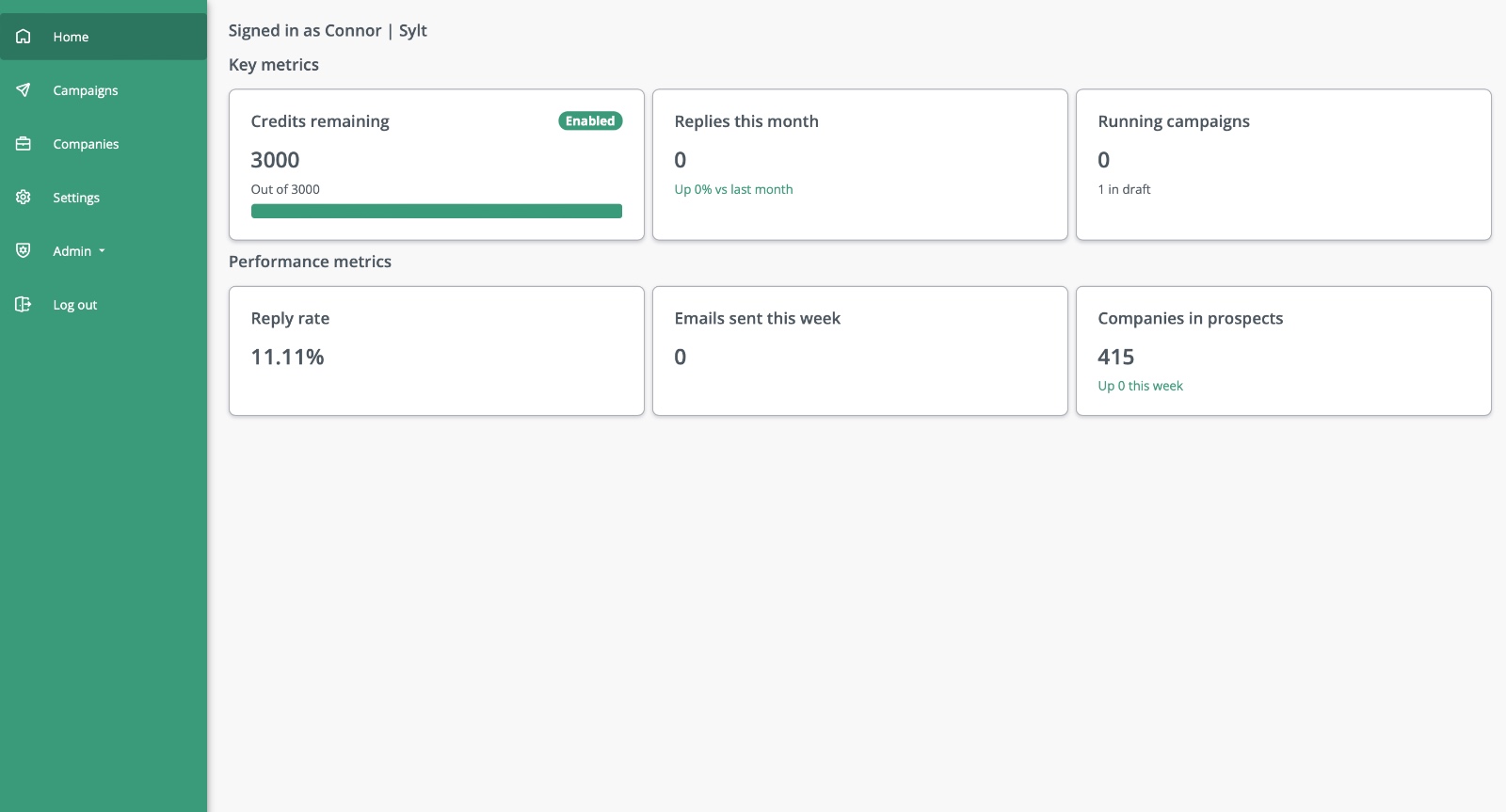
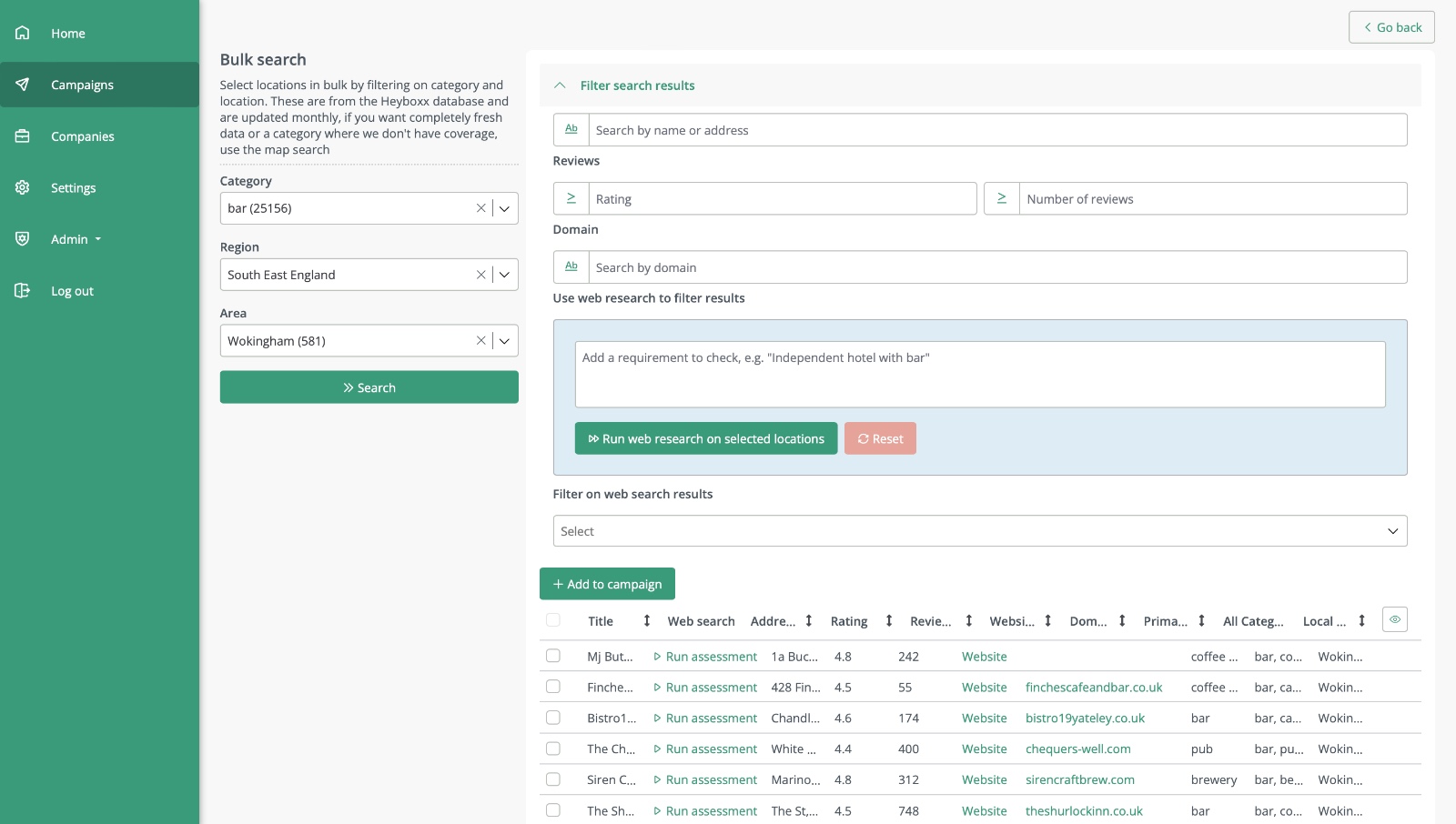
- A database of physical businesses to sell to with a bulk/map search.
- LLMs used to do in depth filtering of places.
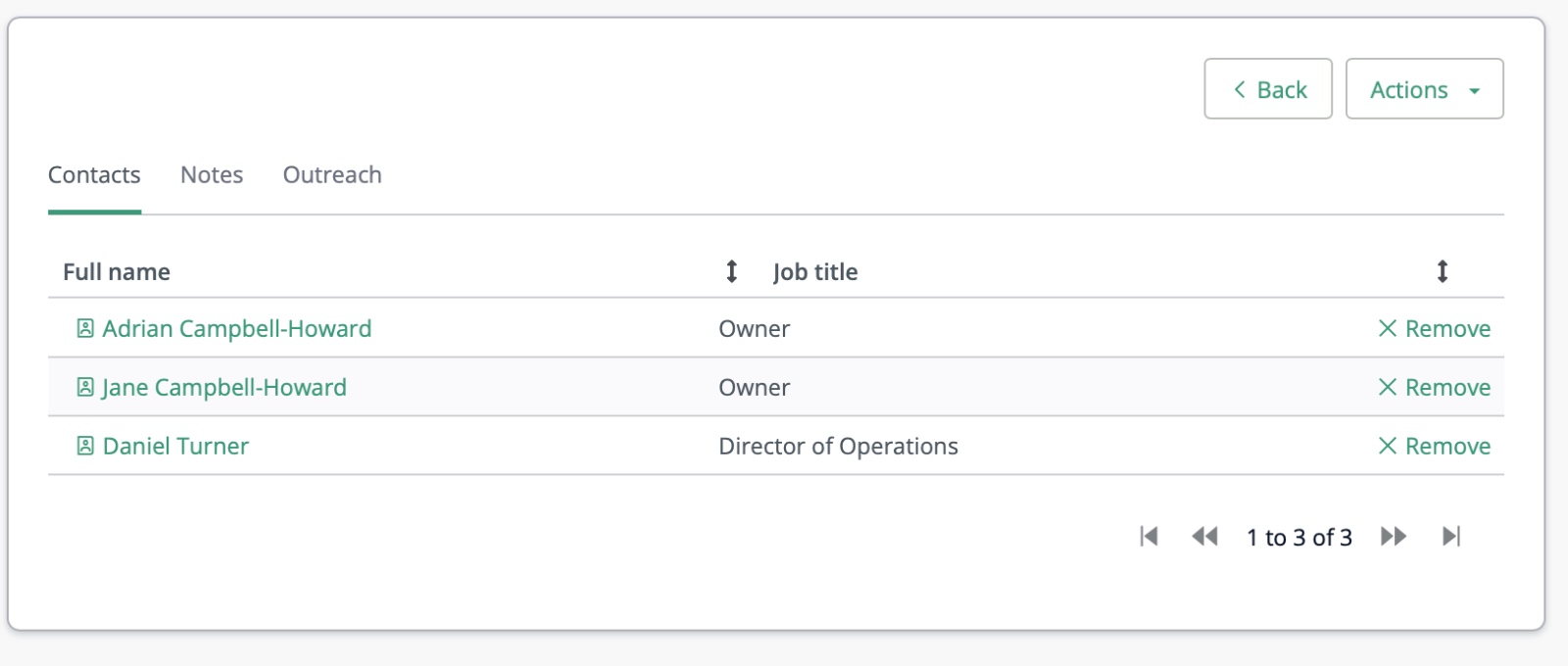
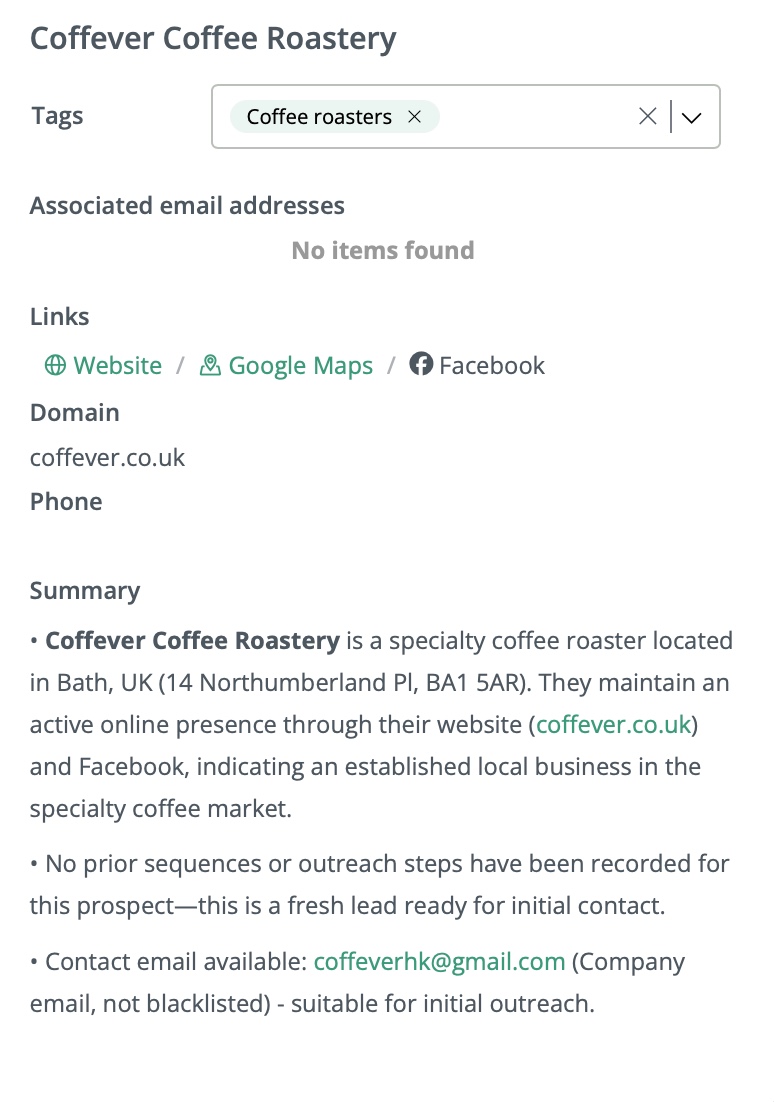
- LLM research (augmented with custom scrapers) to enrich company and contact data.
- A simple sequencer so our users didn't need another piece of software to use the product.
Challenges
Navigating the LLM Hype Cycle
It's reasonably hard to manage a product life-cycle while Sam Altman is announcing the end of capitalism every 6 months. Practically our biggest problem was trying to make our system fully agentic before the technology was ready. Our customers were not naturally sales people, and we were trying to get them to use a product which would be more easily recognised by a BDR or someone in Rev Ops. We thought we could solve this by having the product run entirely autonomously, and then later had to strip back and replace features one by one until we found a balance between automation and quality/reliability.
LLMs in a production environment
Having a system be correct 90% of the time is great for demos, but in production 90% accuracy effectively useless. There were many steps involved in getting useful results.
- Monitoring goes without saying. We built our own suite of LLM specific tests, this was also useful for benchmarking different models for price/quality comparisons.
- Consensus voting, having multiple smaller models run on the same problem and vote on the answer was very helpful. See https://arxiv.org/abs/2511.09030.
- Qualitative checks. More than in traditional systems, quantitative checks rarely tell the full story. For one example, our tests were showing that all contact enrichment was bringing back 3 or 4 contacts at record low token cost. Looking into it in more detail we noticed that every Garden Centre owner being returned in the contacts was called David. Our web search had been misconfigured in the update, and the LLM was just guessing feasible contacts for every location.
Selling to SMEs
It's always tempting to sell to small companies. They're generally more sympathetic to new ventures and less intimidating than enterprise sales. However they are also more conservative when it comes to investing in technology and we found it hard to move from happy user to paying user.
Entity Resolution
One of the most frequently arising problems for us was working out how to model companies and contacts in a domain where there isn't an established identifier. For example there are companies which don't have a domain but have an instagram presence, or only a facebook page, or maybe multiple facebook pages, one for each branch. We eventually settled on domains as the most practical identifier, but there were lots of edge cases remaining for non-email related contact.
Closing Down
After multiple iterations, we did find a small group of users who enjoyed and found value in our product. However this was with subsidised pricing, and still requiring lots of manual intervention on our part to run effective campaigns in the system. Since we were running out of time we unfortunately had to make the hard call that we probably didn't have clear enough product market fit to continue.